Across South and Southeast Asia, the Middle East and beyond, furniture workshops are hitting the same inflection point. Customers who used to accept off-the-shelf designs now want something personal — a different finish, an unusual dimension, a layout that fits a specific room. The demand is there. The question is how to meet it without rebuilding the entire factory.
That tension — between rising customization demand and the reality of a machine configuration built for standard products — is exactly what Nanxing Machinery set out to solve with its entry-level three-machine package. Rather than pushing factories straight into full-scale automation, the line-up meets them where they are: one cutting solution, one edge bander, one drilling centre, each capable of running standalone today and integrating into a digital workflow tomorrow.
The Transition Problem
The hardest part of moving into custom work isnt buying the machines — its the hidden cost of changeover. When every job is different, programming time eats into production time. Operators spend more hours setting up than cutting. And without a way to track individual panels through the process, mistakes multiply. A workshop that once shipped a hundred identical cabinets a day can suddenly find itself struggling to deliver twenty bespoke units on time.
Nanxings approach is pragmatic. Every machine in the three-piece line-up carries digital capability as standard — barcode scanning, PC-based controls, compatibility with industry-standard CAM formats such as MPR, BPP and XML. That means a factory can start in manual mode and layer in design and nesting software when the business case makes sense. The equipment adapts to the workflow, not the other way around.
Panel Cutting: Two Paths, One Decision
Not every workshop cuts panels the same way, and Nanxing gives buyers a genuine choice rather than a one-size-fits-all recommendation.
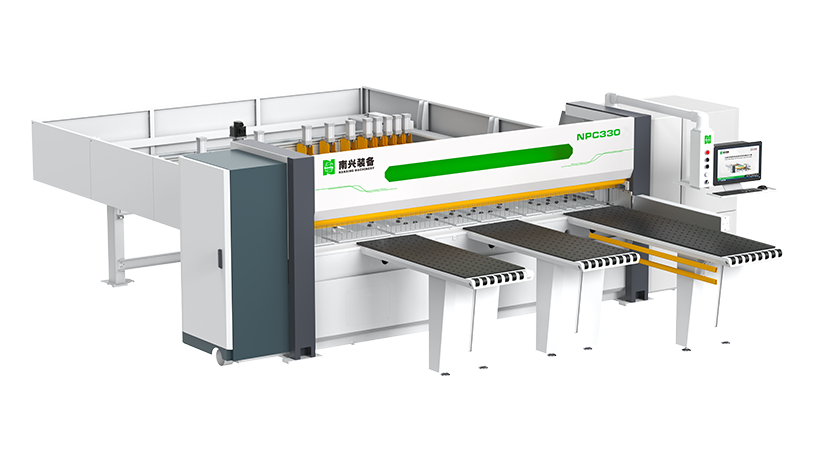
The NPC330 panel saw is built for operations that still run a high proportion of standard panels alongside an increasing mix of custom sizes. It stacks up to six 18 mm sheets at once, rip-cuts narrow strips without length restrictions and delivers a finish quality that minimises downstream edge banding work — less pre-milling means lower glue consumption and tighter joints. Paired with an optimisation package and label printer, it slots neatly into a semi-digital workflow: the saw produces tagged panels that flow directly to the next station.
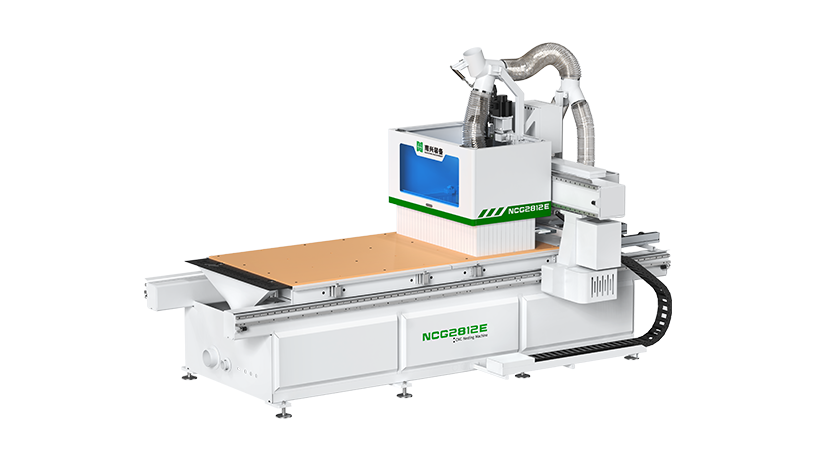
For workshops where almost every sheet is cut to order, the NCG2812E CNC nesting centre offers a different calculus. A router bit doesnt care about panel geometry, so nesting software can squeeze one to three percentage points more yield from every board — a margin that compounds fast when material costs are rising across the region. The NCG2812E also drills vertical holes during the same cycle, eliminating a separate processing step, and one operator can manage multiple machines simultaneously. For a growing operation in, say, Kuala Lumpur or Jeddah that needs flexibility without headcount, that equation matters.
Edge Banding: Buy Once, Band Everything
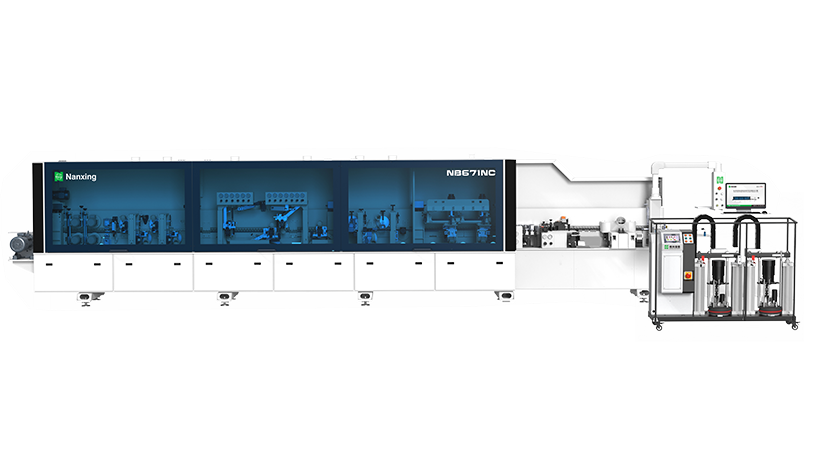
If cutting sets the pace, edge banding sets the quality — and it is the one station where cutting corners almost always shows. Nanxings recommendation is the NB671DNC, a machine that sits firmly in professional territory: linear steel guide rails, a steel beam and a five-ton frame that absorbs vibration the way only mass can. The payoff is consistency — panel after panel, shift after shift.
What makes the NB671DNC relevant to this market segment, though, is its range. It handles EVA and PUR adhesive systems, panels from 7.5 mm up to 60 mm thick, wall panels, back panels, door panels, notched workpieces, skeletal doors and strips as narrow as 35 mm. For a workshop that might be edge-banding kitchen cabinets in the morning and room-length wall panels in the afternoon, that versatility eliminates the need for a second bander. Servo-driven end trimming avoids the quality fluctuations that pneumatic systems suffer when workshop air pressure is inconsistent — a common issue in smaller factories across the region. Four-head contour tracking rounds every corner cleanly. And thickness changes, glue pot swaps and feed-speed adjustments are all handled from a PC interface rather than by reaching into the machine.
The logic is straightforward: buy one bander that covers every product you currently make and every product youre likely to add, rather than trading up in eighteen months.
Drilling: One Machine, Several Jobs
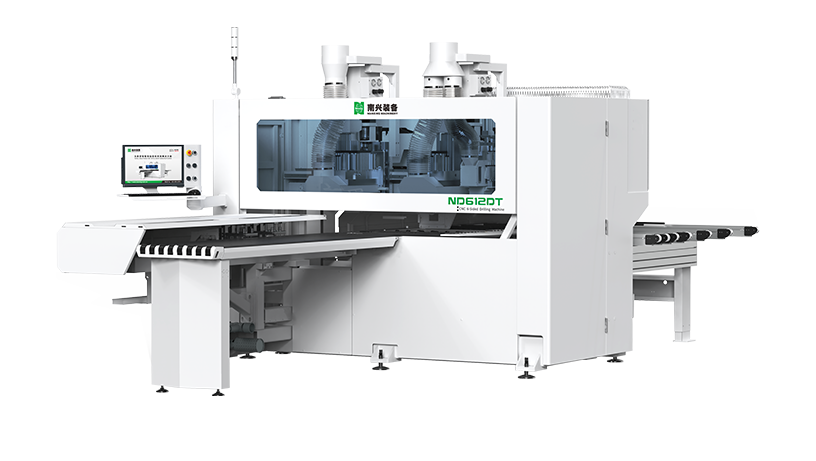
Six-sided drilling centres have become the default for small-batch custom work, and for good reason — they eliminate the fixture changes and repositioning that slow down traditional point-to-point machines. Nanxings ND612DCT is the best-selling model in this class, and the reasons are practical rather than glamorous.
It drills, it grooves, it profiles — and with an 8+2-tool magazine and an auto-change spindle, it does all three in a single setup. For a mid-sized workshop, that means one ND612DCT can replace a dedicated drilling machine, a grooving machine and, for certain operations, a CNC routing centre. One setup, one handling, one set of tolerances. The working range is generous: panels as narrow as 30 mm, as long as 2,800 mm, and from 10 mm to 60 mm thick. Dual drill packs keep cycle times competitive even at higher volumes.
Like the rest of the line-up, the ND612DCT is built for digital adoption from day one. Barcode-activated processing is standard, and the controller accepts MPR, BPP, XML and BAN file formats, which means it will talk to whatever design or production-management software the factory chooses to run — now or in the future.
Built for These Markets
There is a reason this particular combination of machines makes sense for factories in India, Malaysia, the Gulf states and the wider South Asian and Middle Eastern region. These are markets where demand for custom and semi-custom furniture is rising fast, but where many workshops are still running production lines designed for standard products. The capital outlay for a full-scale automated line is hard to justify when the order book is still in transition. What these businesses need is equipment that earns its keep from the first panel, then grows with them.
That is the thinking behind the three-machine line-up. Each unit works productively in a standalone, manually programmed setup. Each one is ready to go digital the moment the factory invests in design and nesting software. And together, they form a coherent production flow — cut, band, drill — that can scale from a few dozen custom units a day to several hundred without replacing a single machine.